

Learn How To Get Court Ordered Mediation through a step-by-step guide. Discover eligibility requirements, filing procedures, and essential tips for successful dispute resolution.
Table of Contents
How To Get Court Ordered Mediation
Are you stuck in a legal fight that’s hard to solve in court? Is there a better way to fix it without all the stress and cost?
Court-mandated mediation is a special way to solve disputes. It’s different from going to court. Here, people work together to find solutions that everyone can agree on.
Finding out how to get court ordered mediation can be tough. This guide will help you. You’ll learn the steps, the good things about it, and how to do well in mediation in the US legal system.
Key Takeaways
- Court ordered mediation is a structured alternative dispute resolution process
- Mediation can significantly reduce legal costs and time spent in court
- The process promotes communication and collaborative problem-solving
- Courts may mandate mediation in various types of legal conflicts
- Preparation is key for successful mediation outcomes
Understanding Court Ordered Mediation
Court ordered mediation is a big help for families and lawyers. It’s a way to solve problems without going to court. This method helps people work together to find solutions.
Divorce and family mediation have changed how we solve legal problems. They help us talk things out and find good solutions together.
Definition of Court Ordered Mediation
Court ordered mediation is when a judge makes you talk things out before going to court. It has a few key parts:
- Mandatory participation by involved parties
- Neutral third-party mediator supervision
- Structured negotiation framework
- Confidential discussion environment
Purpose and Benefits of Mediation
The main goals of court ordered mediation are:
- Reducing court system backlog
- Minimizing emotional stress for participants
- Developing cooperative problem-solving skills
- Generating cost-effective solutions
How It Differs from Traditional Court Proceedings
| Mediation Characteristics | Traditional Court Proceedings |
|---|---|
| Collaborative approach | Adversarial approach |
| Flexible resolution strategies | Rigid legal procedures |
| Mutual decision-making | Judge-imposed decisions |
| Lower financial costs | Higher litigation expenses |
Mediation lets people help make solutions. It turns fights into chances to solve problems together.
When Is Court Ordered Mediation Required?
Courts in the United States see mediation as key for solving legal problems fast. It’s very important for families in child custody cases to find peaceful ways to solve their issues.
The legal system uses court-annexed mediation for many disputes. It aims to find solutions that both sides can agree on, avoiding long court fights.
Circumstances Mandating Mediation
Some legal situations make mediation a must. These include:
- Family law disputes over child custody
- Divorce cases with disagreements about kids
- Changes in child support
- Talks about guardianship and parental rights
A skilled guardianship attorney in St. Louis can guide families through complex legal decisions with clarity and care. Mediation helps resolve disputes peacefully without lengthy court battles. Families gain confidence knowing their loved ones’ best interests are protected.
Types of Cases Suitable for Mediation
| Case Type | Mediation Suitability |
|---|---|
| Child Custody Disputes | High |
| Property Division | Moderate |
| Spousal Support | High |
| Parental Relocation | Very High |
Judicial Discretion in Ordering Mediation
Judges have a lot of freedom in deciding if mediation is needed. Mediation Requirements can change based on the case’s complexity and the chance of a peaceful solution. They also look at state laws.
Courts want to find solutions that reduce stress and help families work together. This is very important in family law cases.
Steps to Request Court Ordered Mediation
Going through the Court Mediation Process needs careful planning. You must know the legal steps well. To ask for court ordered mediation, you must follow certain steps. This ensures your request is filed right and considered by the court.
First, learn what your local court needs. Each place has its own rules for starting mediation.
Filing a Motion for Mediation
To begin the court ordered mediation steps, do this:
- Find the right court for your case
- Make a formal motion for mediation
- Show why mediation fits your situation
Required Documentation and Forms
For a good mediation request, you’ll need:
- A filled-out court mediation request form
- Proof you filed your case
- Reasons why you need mediation
- How to reach all parties involved
Timeframes for Filing Requests
Time is key in court ordered mediation. Most courts have specific times for filing mediation requests. Talk to your local court clerk to find out the exact times and rules for your area.
Be ready to share lots of details about your case. Show that you really need mediation. The court will look at each request to see if mediation is right.
How to Prepare for Court Ordered Mediation
Going to court-ordered mediation needs careful planning. The Mediation Help Center says to do a lot of work before. Knowing what to expect and being realistic is key to doing well in mediation.
Good preparation has many parts. These parts can really help your mediation go well.
Gathering Necessary Evidence
It’s very important to gather all the right documents. Here are some things you might need:
- Financial records and statements
- Communication logs
- Relevant contracts or agreements
- Photographic or video evidence
- Expert reports or assessments
Understanding the Mediation Process
The Mediation Hearing Guide says it’s important to know what happens in mediation. Mediation is different from going to court. It’s about working together to solve problems.
| Stage | Key Activities |
|---|---|
| Introduction | Mediator explains ground rules and process |
| Opening Statements | Each party shares their perspective |
| Negotiation | Exploring possible solutions |
| Agreement | Drafting a solution both sides can agree on |
Tips for Effective Participation
To do well in mediation, you need a smart and calm approach:
- Stay calm and professional
- Listen well to the other side
- Think about solutions for the future
- Be ready to give in a bit
- Have realistic hopes
By following these tips, you can go into mediation feeling ready. This can help you find a good solution for everyone.
Finding a Qualified Mediator
Choosing the right mediator is key for a good Mandatory Mediation in Family Court Mediation. The mediator helps guide parties to a solution. They also help with the legal and emotional parts of the case.
Key Criteria for Mediator Selection
When picking a mediator, look at a few important things. Experts say to focus on these qualifications for good mediation:
- Specialized expertise in family law
- Professional certification in mediation
- Extensive experience in dispute resolution
- Neutral and impartial communication skills
Resources for Locating Qualified Mediators
Looking for a good mediator takes some work. Here are some places to start:
- State bar association referral services
- Local family court mediation programs
- Professional mediation organizations
- Online legal directories specializing in mediation
Evaluating Mediator Qualifications
Checking a mediator’s qualifications is important. Look for someone with demonstrable experience in similar cases. Ask for references, check their credentials, and have a first meeting to see if you click.
A matrimonial attorney with mediation training is a great choice. They know the law well and can help solve conflicts.
The Mediation Process Explained
Going through mediation can be tough, like in Judge Ordered Mediation. Knowing the steps helps you get ready and feel sure in Custody Mediation Court.
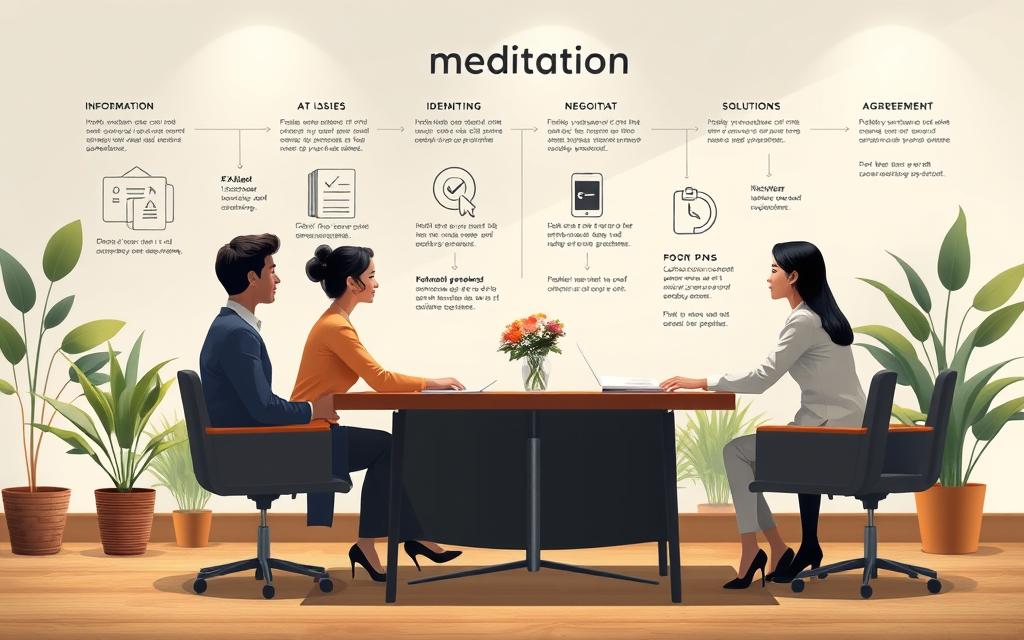
The mediation process has a clear plan to help talk things out and solve problems. Everyone works together to understand each other better and find solutions.
Pre-Mediation Conference
First, there’s a meeting to get ready for the big talk. Here, you’ll:
- Learn about the mediation rules
- Set rules for talking nicely
- Know about keeping things private
- Talk about things you might agree on
The Role of the Mediator
A mediator is a neutral person who helps the talk. They do:
- Make sure everyone talks openly
- Make sure everyone gets a say
- Help find solutions together
- Keep things moving and on track
What Happens During the Mediation Session?
The mediation session goes through important steps. It’s a lively and interactive way to solve problems together in Custody Mediation Court.
Steps include opening talks, group chats, private talks, and negotiating. Each step helps build understanding and find solutions everyone can agree on.
What to Expect During Mediation
Going through a divorce can be tough, with lots of feelings involved. Mediation is a way to solve problems in a calm setting. It helps people work together to find solutions.
Knowing what mediation is about helps you get ready. Laws in California make sure it’s a place where both sides can talk and find common ground.
Duration of Mediation Sessions
Mediation sessions usually last 2-4 hours. How long it takes depends on a few things:
- How complicated the issues are
- How emotional the people are
- How willing they are to agree
- How many things need to be solved
Confidentiality in Mediation
Keeping things private is very important in mediation. Everything said stays between the people in the room. This lets them talk openly without worrying about legal trouble later.
Handling Emotions and Conflict
Keeping calm is key in mediation. Trained mediators help by:
- Making the atmosphere calm
- Handling strong feelings
- Helping conversations stay on track
- Encouraging solving problems together
By staying calm and working together, people can turn arguments into chances to solve problems together.
Understanding the Outcome of Mediation
Family Court Mediation helps solve family disputes in a special way. It has many possible results that can change families a lot. This process lets people find agreements without going to court.
Understanding a Divorce Mediation Court Order’s results is key. You need to know what might happen during mediation.
Possible Results of Mediation
Mediation usually ends in three main ways:
- Full Agreement: All issues are solved
- Partial Agreement: Some issues are solved, others not
- No Agreement: No agreement is reached
How Agreements Are Formalized
When an agreement is made, it needs to be checked and made official. It’s a good idea to have your lawyer look at it. This makes sure your rights are safe.
| Agreement Type | Formalization Process | Legal Standing |
|---|---|---|
| Full Agreement | Attorney Review and Court Submission | Becomes Binding Court Order |
| Partial Agreement | Partial Terms Reviewed, Remaining Issues Addressed | Partially Binding |
| No Agreement | Return to Traditional Litigation | No Binding Terms |
Next Steps If Mediation Is Unsuccessful
If mediation doesn’t work, it’s not the end. You can try other ways to solve problems or go to court.
Even if mediation fails, it can help improve how you talk to each other.
Common Myths About Court Ordered Mediation
Court-mandated mediation often faces misunderstandings. These misunderstandings stop people from seeing its value. Many think mediation is not good for solving big problems.
The Mediation Help Center sees many wrong ideas about mediation. These ideas make people not want to try mediation. Let’s look at and clear up some big myths about court-ordered mediation.
Misconceptions About Effectiveness
Some think mediation is only for small issues. They also think it shows they are weak. But, mediation is great for solving big problems. It has many benefits:
- Allows direct communication between parties
- Provides a neutral environment for discussion
- Empowers participants to create mutually beneficial solutions
Myths Surrounding Confidentiality
Many worry about keeping things private in court-mandated mediation processes. They fear their talks could be used against them later.
| Confidentiality Myth | Actual Practice |
|---|---|
| All discussions are public | Mediation conversations remain private |
| Mediator can testify in court | Mediators are legally protected from testifying |
Deconstructing Cost Myths
Many think mediation costs a lot. But, mediation is usually cheaper than going to court. It takes less time and costs less money.
- Lower attorney fees
- Faster resolution times
- Reduced court expenses
Knowing these myths helps people see mediation in a better light. They can go into it with the right mindset.
Potential Costs Associated with Mediation
Understanding the costs of court-ordered mediation can be tough. Knowing what to expect helps you plan better. This way, you can make smart choices about the Court Mediation Process.

Mediation costs can change a lot. They depend on several important things. These include the fees for mediators, the costs for running the mediation, and any extra expenses.
Fees for Mediators
Mediators charge in different ways:
- Hourly rates from $100 to $500
- Flat fees of $250 to $1,000 for a session
- Extra fees for getting ready and following up
Additional Costs to Consider
| Cost Category | Estimated Range |
|---|---|
| Document Preparation | $50 – $250 |
| Administrative Fees | $25 – $100 |
| Potential Legal Consultation | $200 – $500 |
Options for Cost Assistance
If money is tight, there are ways to save:
- Court programs that help with costs
- Fees that change based on how much you make
- Free mediation services for those who can’t pay
- Plans to pay the mediator over time
Pro tip: Always talk about fees first. Make sure you know all the costs before starting mediation.
Legal Implications of Mediation Agreements
Understanding mediation agreements is key. They are legally binding and enforceable. Laws in California help settle disputes through mediation.
The divorce process in court can be complex. It affects the final agreement. Knowing the legal sides of mediation is important for both sides.
Binding vs. Non-Binding Agreements
Mediation can lead to two kinds of agreements:
- Binding Agreements: These are legally enforceable and court-approved
- Non-Binding Agreements: These are just suggestions that need both sides to agree
Enforcing Mediated Agreements in Court
To enforce a mediation agreement in court, follow these steps:
- Send the agreement to the court for review
- Get approval from a judge
- Make the agreement a court order
| Agreement Type | Legal Status | Enforcement Mechanism |
|---|---|---|
| Binding Agreement | Fully Enforceable | Court Order |
| Non-Binding Agreement | Voluntary Compliance | Negotiation/Renegotiation |
Understanding State-Specific Laws
Legal rules change from place to place. California has its own rules for mediation. Knowing these rules is vital for making agreements work.
The Role of Attorneys in Court Ordered Mediation
Going through divorce mediation can be tough. Having a lawyer is key to protect your rights in the family law mediation process. Knowing how important lawyers are can really help your case.

Do You Need a Lawyer?
Having a lawyer in divorce mediation is not always needed. But, it can really help. Lawyers give advice and watch out for your interests. Here are some reasons why you might want a lawyer:
- Protect your legal rights
- Provide objective advice
- Ensure fair agreement terms
- Interpret complex legal language
How Attorneys Can Assist You
Family law attorneys have special skills for divorce mediation. They can help you:
- Prepare important documents
- Plan how to negotiate
- Check if agreements are good
- Help understand legal stuff
Collaborative Strategies with Legal Representation
Good communication between lawyers can make mediation easier. Working together can lead to better solutions for everyone.
| Strategy | Benefit |
|---|---|
| Open Communication | Reduces conflict and misunderstandings |
| Shared Problem-Solving | Creates win-win solutions |
| Focused Negotiation | Minimizes emotional tension |
Remember, the right legal support can make your divorce mediation better.
After Mediation: What Comes Next?
After court ordered mediation, things can get tricky. It’s not always a complete fix. But, it’s a good start for moving forward.
When mediation ends, you have choices. The guide says to know what you got and get ready.
Implementing the Mediation Agreement
Agreements need to be followed. Here’s how:
- Write down what you agreed on
- Get the court to approve it
- Make it a legal document
- Make sure everyone knows what to do
Preparing for Possible Court Hearings
If you didn’t solve everything, you might need court. The steps say to:
- Look at what’s left to solve
- Find out what’s not agreed on
- Use what you learned from mediation
- Talk to a lawyer
Feedback and Process Evaluation
Thinking about mediation helps make future ones better. Share your thoughts with the mediator or court.
| Mediation Outcome | Recommended Next Steps |
|---|---|
| Full Agreement Reached | File agreement with court, implement terms |
| Partial Agreement | Schedule additional mediation or court hearing |
| No Agreement | Proceed to traditional court litigation |
Mediation is flexible. Future chances for solving things may come up as things change or people grow closer.
Resources for Further Information
Finding your way through the Court Mediation Process can be tough. But, there are many resources to help you. The Florida Courts website has lots of help. It teaches you about different ways to solve disputes.
Choosing a mediator is important. Look at the American Arbitration Association and local Mediation Help Centers. They have lists of good mediators for different kinds of cases.
Legal aid groups help if you can’t afford mediation. They offer free or cheap advice. They help you know your rights and get ready for mediation.
For more info, check out national mediation groups and local court sites. Online forums also help. They give you tips and support during tough times.

