

Imagine living in a society where every major decision—from your career path to the food on your table—is dictated by centralized authority. This is the reality for millions under state-controlled economic systems, where governments prioritize collective planning over individual autonomy. Countries like North Korea and Cuba exemplify this model, directing resources, production, and even housing through rigid central policies.
While proponents argue these systems eliminate inequality and ensure basic needs, critics highlight their hidden costs. Housing shortages in Pyongyang or Havana, for instance, reveal how centralized resource allocation often clashes with personal aspirations. Employment opportunities rarely align with individual skills, leaving workers trapped in roles assigned by planners.
This article examines how such top-down decision-making reshapes daily life. From limited consumer options to restricted entrepreneurship, we’ll analyze historical and modern cases where government dominance in markets alters societal dynamics. Can stability coexist with freedom? Let’s explore.
Table of Contents
Key Takeaways
- Central planning prioritizes state goals over individual preferences
- Governments control housing, jobs, and essential goods in command economies
- North Korea’s food rationing system demonstrates centralized resource distribution
- Promised stability often leads to innovation stagnation
- Citizens face limited career mobility under state-assigned employment
- Consumer markets lack diversity in government-controlled systems
Introduction to Command Economies
In systems where national priorities dictate every factory’s output and every store’s inventory, centralized economic planning replaces market mechanisms. These structures prioritize state objectives over individual preferences, creating distinct advantages and challenges.
Defining a Command Economy
A command economy operates through government ownership of production assets. State agencies determine which goods services get manufactured, often ignoring price signals or consumer trends. This contrasts sharply with market-driven systems where supply and demand guide outcomes.
Purpose and Key Characteristics
Central planners allocate resources based on predefined goals rather than consumer demand. For example, 78% of Cuba’s workforce remains employed in state-assigned roles to maintain employment stability. Bureaucratic committees replace competition, focusing on quotas for industries like steel or agriculture.
Countries adopt this model to control inflation and ensure universal access to basics like healthcare. However, rigid frameworks often lead to inefficiencies—factories might overproduce unneeded items while essentials face shortages. This disconnect between planning and real-world needs shapes daily experiences in profound ways.
What is one way a command economy affects the lives of private citizens?
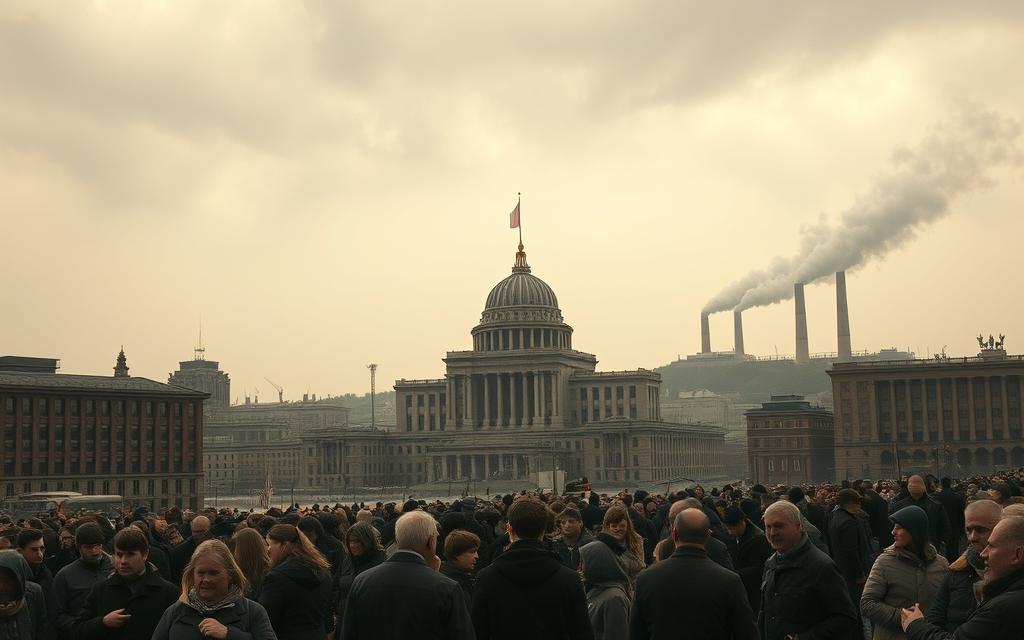
Daily routines in state-controlled systems reveal a stark imbalance between centralized priorities and individual needs. Authorities determine which products reach store shelves, how much they cost, and who qualifies to buy them—often without public input.
Government-Driven Economic Decisions
Central planners set production quotas based on political objectives rather than market signals. Factories might prioritize manufacturing tractors over bicycles simply to meet agricultural targets, even if families need transportation. This approach creates mismatches between supply and demand.
Real-Life Implications on Daily Living
Regulated pricing often leads to empty shelves and long queues. In Venezuela, government-controlled price caps caused 70% of basic goods to vanish from markets by 2018. Cuban households wait years for state-approved refrigerators while using decades-old appliances.
| Government Goals | Citizen Impact | Example |
|---|---|---|
| Price stability | Fixed costs but chronic shortages | Bread priced at $0.10 but unavailable |
| Resource allocation | Ration cards for essentials | Cuba’s libreta system for rice/oil |
| Production targets | Limited product diversity | East Germany’s 3 car models (1980s) |
These systems leave little room for personal preferences. When Moscow banned blue jeans in the 1970s to promote domestic clothing, youth resorted to black-market trades. Such restrictions demonstrate how centralized authority reshapes consumption patterns and stifles individuality.
Effects on Consumer Choices and Product Variety
Walking into a state-run store reveals a world of uniformity. Shelves display identical goods—standardized apples, unbranded flour, and plain soap bars. This sameness stems from centralized production targets that value quantity over diversity.
Limited Product Diversity in State-Run Markets
Central planners prioritize basic necessities rather than variety. A typical government store in 1980s East Germany stocked only three types of canned vegetables. With no competition, factories produce what meets quotas—not what consumers desire.
- Only 2-3 clothing styles available per season in Soviet department stores
- Zero specialty items like gluten-free flour or scented detergents
- Identical packaging across regions to simplify distribution
Impact on Personal Preferences and Consumer Freedom
When Moscow mandated potato-based bread recipes in the 1970s, bakeries eliminated wheat options—ignoring public taste. Such decisions show how market control erodes individual choices.
Innovation stalls without competitive pressure. Cuban appliance factories still produce 1950s-style refrigerators because redesigns require state approval. This rigidity leaves access to modern conveniences decades behind global trends.
The result? A population conditioned to accept “good enough” rather than seek better products. Creativity withers when every store shelf whispers the same message: conformity over customization.
Impact on Employment, Wages, and Innovation
In economies where job roles are assigned rather than chosen, personal ambition collides with bureaucratic mandates. Central planners prioritize production quotas over individual talents, creating systemic inefficiencies that ripple through entire industries.
Standardized Job Assignments and Rigid Wage Structures
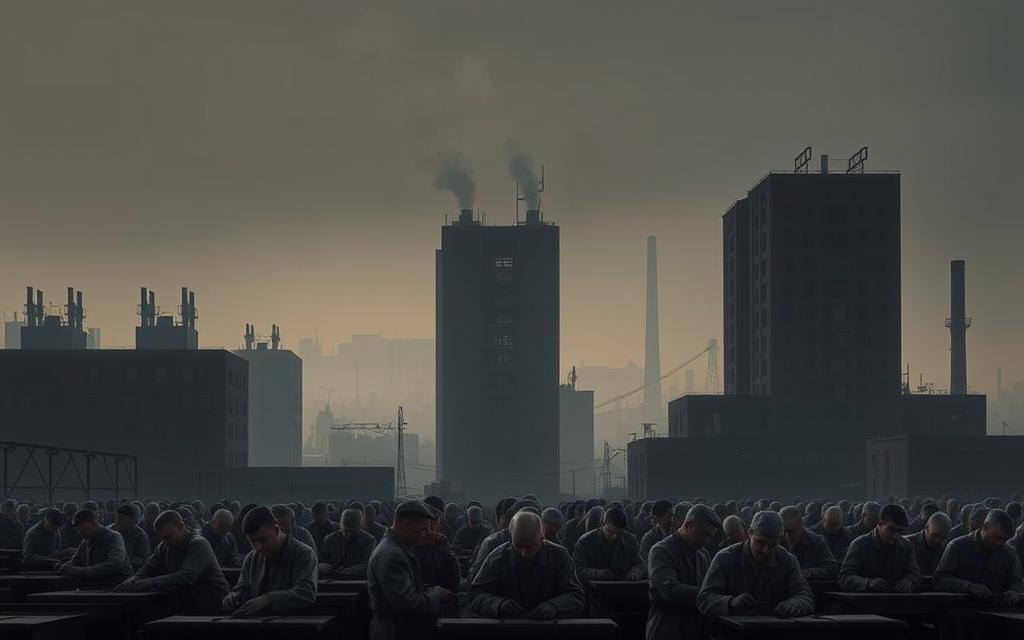
Governments often funnel workers into factories or collective farms regardless of skills. Cuba’s labor ministry still assigns 85% of workers to state jobs—architects might clean streets while engineers operate tractors. Wage scales rarely reflect performance. A Soviet factory worker producing 150% of their quota received the same pay as someone meeting minimum targets.
This system creates three critical issues:
- No financial incentive for exceptional work
- Mismatched skills wasting human potential
- Persistent worker dissatisfaction
Suppression of Innovation in Production
When businesses can’t compete, innovation stalls. East German factories produced the same plastic furniture designs for 40 years because redesigns required state approval. North Korea’s textile mills still use 1950s-era looms despite global advancements.
Centralized control eliminates market feedback loops. Planners focus on quantity, not quality—resulting in shoes that disintegrate in rain or tractors prone to breakdowns. The absence of private enterprise means no one challenges outdated methods or introduces new technologies.
While guaranteed jobs provide surface-level stability, they sacrifice personal growth and societal progress. Workers become cogs in a machine designed for uniformity rather than excellence.
Centralized Control and Limited Economic Freedom
How does complete state authority over resources reshape both markets and personal freedom? Central planners often prioritize system efficiency over individual needs, creating ripple effects across entire economies. This approach to centralized resource management replaces market-driven flexibility with rigid bureaucratic decisions.
Government Oversight of Resource Allocation
When government agencies control raw materials and production chains, diversity suffers. Factories receive quotas for specific goods—like Cuba’s sugar mills producing surplus exports while milk shortages plague local markets. These decisions prioritize political goals over consumer demand.
Three critical issues emerge from this model:
- Chronic shortages of household essentials alongside unused stockpiles
- Standardized products that ignore regional preferences
- Delayed responses to changing needs due to approval processes
State control creates artificial stability at the cost of adaptability. Soviet planners once ordered excessive tractor production while cities lacked basic appliances. Such misallocations reveal how centralized resources management struggles with real-world complexity.
The tension between guaranteed access and restricted choice defines these systems. Citizens gain predictable prices but lose the ability to shape their economic lives—a trade-off that continues sparking global debates.
Real-World Examples and Historical Illustrations
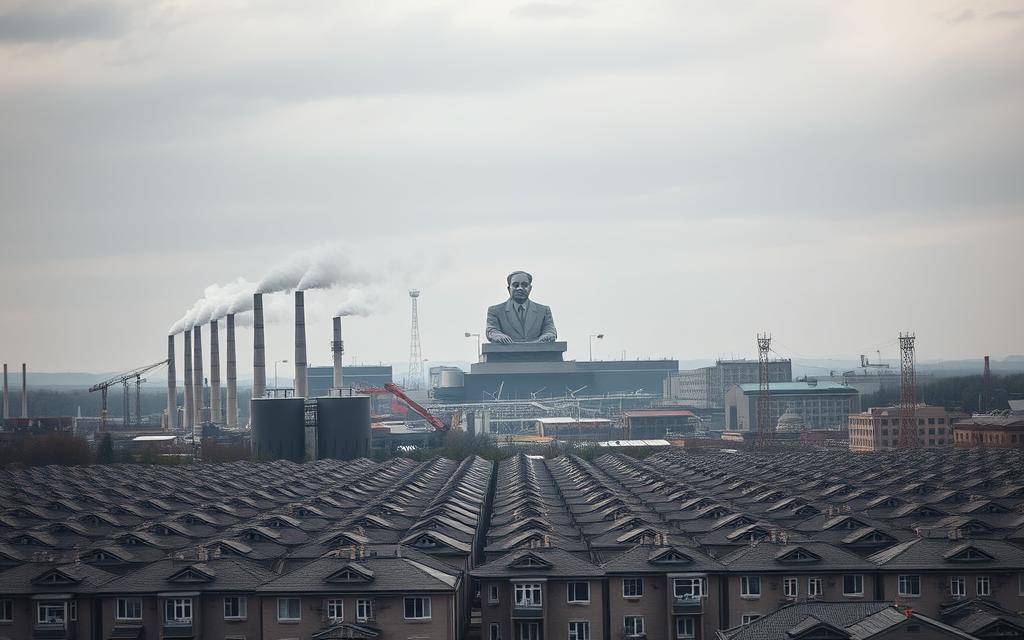
Pyongyang’s identical apartment blocks stretch for miles, each unit assigned based on political loyalty rather than personal preference. This physical landscape mirrors the rigid structures of command economies, where state priorities shape every aspect of daily existence. Historical records reveal how centralized systems achieved short-term goals while creating long-term challenges.
Case Study: North Korea’s Housing and Employment
In Pyongyang, housing allocations follow a strict hierarchy. Military officers receive modern apartments near government centers, while factory workers get cramped units in industrial zones. The state assigns 92% of workers to roles matching their education level and family background—a system designed to control dissent through economic dependency.
Three patterns emerge from this approach:
- Loyalty-based housing creates visible social stratification
- Mandatory job placements suppress career aspirations
- State-controlled salaries eliminate financial motivation
Lessons from the Soviet Union and East Germany
Moscow’s 1970s push for industrial growth produced remarkable steel output but left stores empty of consumer goods. East German planners achieved full employment yet couldn’t meet basic demand for quality clothing or electronics. These economies collapsed when centralized models failed to adapt to global market shifts.
Modern hybrid systems like China’s show improved results by blending planning with market elements. However, historical examples remind us that complete state control often sacrifices innovation for temporary stability—a trade-off visible in today’s remaining command economies.
Addressing Criticisms and Misconceptions
Debates about centralized economic models often overlook their systemic contradictions. While advocates emphasize guaranteed services and social safety nets, critics argue these systems create hidden costs that undermine their stated goals.
Misallocation of Resources and Inefficiencies
Centralized decision-making frequently results in absurd mismatches between supply and need. Soviet planners in the 1980s ordered excessive wheat production in Kazakhstan while Ukraine’s fertile fields lay underused—a geographic paradox created by rigid quotas.
Three persistent patterns emerge:
- Stockpiles of unneeded goods rotting in warehouses
- Critical shortages of medical supplies despite surplus steel production
- Energy grids wasting coal to meet output targets (East Germany burned 3x more coal per capita than Western neighbors)
Understanding the Trade-Offs of Security vs. Freedom
The promise of stability through services like free housing often masks eroded autonomy. Cuban citizens receive subsidized utilities but face 15-year waits for state-approved cars. This tension between collective guarantees and personal choices defines daily life.
| Theoretical Benefit | Practical Outcome | Example |
|---|---|---|
| Price controls | Empty shelves | Venezuela’s 2018 flour crisis |
| Guaranteed jobs | Skill mismatches | Soviet engineers driving tractors |
| Universal healthcare | Medication shortages | Cuba’s aspirin rationing |
Historical evidence from failed socialist experiments shows how market suppression stifles problem-solving. When Moscow banned private tech ventures in 1975, innovation shifted underground—creating a shadow economy of makeshift repairs and bartered services.
True economic freedom requires balancing security with adaptability—a equilibrium centralized systems struggle to achieve.
Conclusion
Behind the Iron Curtain of centralized planning lies a paradox: guaranteed basic services come shackled to stifled ambitions. Historical cases from Soviet breadlines to Cuban housing queues reveal how government-controlled systems trade personal agency for collective stability. While employment security and subsidized utilities provide surface-level comfort, they mask deeper cracks in economic flexibility.
State-mandated production quotas create predictable shortages—identical refrigerators in Havana, rationed aspirin in Pyongyang. Workers become chess pieces moved by planners, their skills mismatched to assigned roles. Innovation withers when market feedback gets replaced by bureaucratic checklists.
Yet modern hybrid models suggest alternatives. China’s blend of planning and entrepreneurship demonstrates how controlled reforms can boost productivity without sacrificing social safety nets. The lesson? Absolute central authority often fails to balance human needs with systemic efficiency.
As debates about economic policies evolve, understanding these trade-offs becomes vital. True progress lies not in choosing between freedom and security, but in crafting systems that respect both collective goals and individual choices.

